
ChatGPT
OpenAI’s ChatGPT is a sophisticated natural language processing (NLP) tool which is adept at text production, language translation, and conversational AI. This technology has been trained using a vast set of data, thus enabling it to generate text with remarkable accuracy that appears to be composed by a human.
Key features
The primary focus of ChatGPT is the capacity to generate text with clarity and fluency. For instance, when presented with a query such as “I am going to the store to buy some groceries. I need to get”, the model can generate a list of commonly found items in a grocery store. Moreover, ChatGPT can take a given text and create a fluent continuation of it, a function known as Text-Completion. This capability can be applied to create news articles, stories, and even poetry.
Use cases
ChatGPT is equipped with language translation capabilities that are highly precise. This feature can be used to facilitate communication between people who speak different languages or to enhance the dialog between humans and machines.

ChatGPT is a tool that can help unleash your creativity and curiosity. With its ability to understand and generate human-like text, the possibilities are endless. Imagine being able to write a novel, compose a poem, or even create your own script for a movie, all with the help of ChatGPT. Not only that, but it can also help you learn new languages and understand different cultures.
ChatGPT is not just a tool for professionals in the field of creative writing or language, it’s for everyone who wants to explore their imagination and curiosity. With the help of this technology, you can bring your ideas to life in a way that was never before possible.
It’s no wonder that ChatGPT is so popular among young people and creatives, it has the ability to help us express ourselves in new and exciting ways. It’s a tool that can help us push the boundaries of what we thought was possible. So, if you’re a young creative or curious individual, don’t be afraid to explore ChatGPT and see what it can do for you. Who knows where it might take you!

Another key feature of ChatGPT is its ability to understand and respond to natural language inputs. This allows it to be used in conversational AI applications, such as chatbots. For example, a chatbot powered by ChatGPT can understand and respond to questions from users in a natural and human-like manner. This can be used to provide customer service, provide information, or even entertain users.
One extremely good use case for ChatGPT would be in the field of customer service. A company could use ChatGPT to create a chatbot that can understand and respond to customer inquiries in a natural and human-like manner. This can help the company save time and resources, as the chatbot can handle a high volume of customer interactions simultaneously. Additionally, the chatbot can be programmed to understand and respond to a wide range of customer inquiries, from simple questions about products or services to more complex issues that require specialized knowledge. This can help the company improve customer satisfaction by providing quick and accurate responses to customer inquiries.
Summary
In summary, ChatGPT is a powerful language model that can be used for a variety of NLP tasks. Its main focus is on generating fluent and coherent text, understanding and responding to natural language inputs, and performing language translation. Its ability to understand and generate human-like text makes it a valuable tool for a wide range of applications, from chatbots to language translation and beyond.
ChatGPT is a powerful language model that has the ability to understand and generate human-like text. This has the potential to revolutionize communication in a number of ways. For example, ChatGPT can be used to generate human-like responses in chatbots, making it possible for businesses to provide 24/7 customer service with a high degree of natural language understanding. It can also be used to generate automated content, such as news articles or product descriptions, which can help to save time and resources.
Additionally, ChatGPT can be used to improve natural language processing tasks, such as machine translation and text summarization, which can help to make information more easily accessible to a wider audience. In short, ChatGPT has the potential to greatly improve the efficiency and effectiveness of communication in a wide range of applications.
User Interface
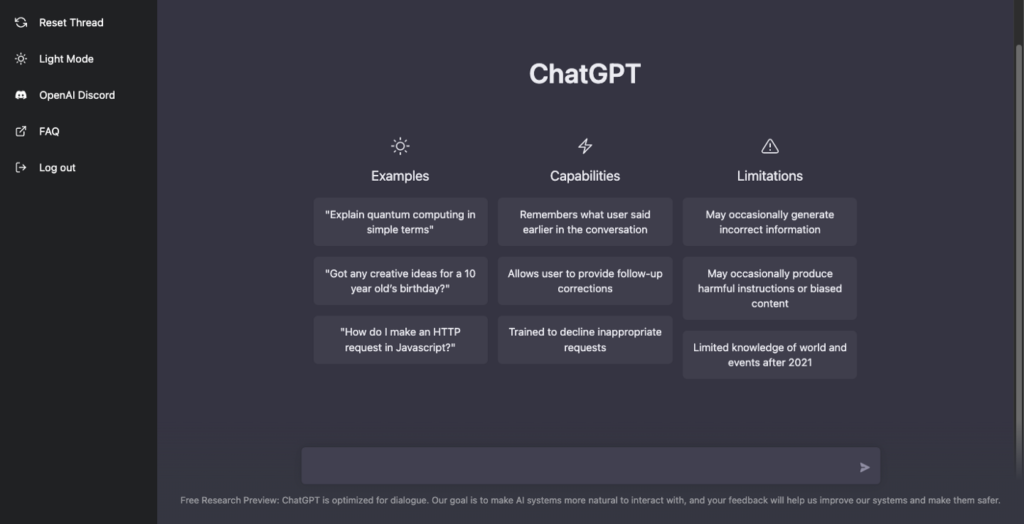
ChatGPT is designed to be user-friendly and intuitive, so that users can easily interact with it and get the results they need in no time. The UI typically consists of a text input field where users can enter their prompt or question, and a text output field which displays the generated text or response. Depending on the platform, the user may also be able to adjust settings or save or export the generated text. Another way to use ChatGPT is through an API, where the developer is responsible for creating the UI and UX that best fits their application.
In the case of using the API, the user interface is the application the developer is building and the user experience is the natural interaction the user has with the application. The developer is responsible for building the UI and UX that best fit the purpose of the application, ChatGPT only provides the language generation capabilities.
ChatGPT Origin
Back in the days of yore, at OpenAI, we were awestruck by the power of language and how it can be used to solve so many problems. We realized that the current technology for processing natural language wasn’t up to par, and that we needed something even more powerful.
They set out to create a new language model that could understand and generate human-like text with high accuracy. They spent countless hours researching and experimenting with different techniques, and eventually, after months of hard work, they succeeded in creating ChatGPT.
ChatGPT was created with the goal of making natural language processing more user-friendly and accessible for everyone. The scientists and engineers who created it wanted to create a tool that could be used for a variety of purposes, such as text generation, language translation, and conversational AI. They wanted to make it easy for businesses, organizations, and individual users to communicate and understand information in a more efficient and effective way.
At OpenAI, we know that ChatGPT is a powerful tool that can change the way we interact with language and technology. Since its inception, it has been helping people and businesses achieve their goals.
Use cases for ChatGPT
Generating coherent and fluent text
ChatGPT can be used to generate news articles, stories, and even poetry. For example, a news organization can use ChatGPT to generate summaries of news articles, which can save time and improve efficiency.
Conversational AI
ChatGPT can be used to create chatbots that can understand and respond to natural language inputs. This can be used in customer service, providing information, or even entertainment. For example, an e-commerce company can use a chatbot powered by ChatGPT to assist customers in finding the products they are looking for and answering their questions.
Conversational interfaces for IoT devices
The framework can be used to create conversational interfaces for IoT devices such as smart home devices. For example, a smart home device manufacturer can use the framework to create a chatbot that can understand and respond to natural language input and control the device.
Language Translation
ChatGPT can be used to translate text from one language to another with high accuracy. This can be used in a variety of applications, such as improving machine-human interaction, or helping people communicate with each other across languages. For example, a global company can use ChatGPT to translate their website and customer service chats to different languages, making it easier for customers to access their services.
Text-Completion
ChatGPT can complete a given text and generate a coherent continuation of the same text. This can be used in a variety of applications, such as generating emails, reports or even completing a code. For example, a software developer can use ChatGPT to generate the missing parts of a code and test it before integrating it to the final product.
Summarization
ChatGPT can be used to summarize long documents into shorter versions, this can be used in a variety of applications such as legal documents, medical reports, and research papers. For example, a researcher can use ChatGPT to summarize a large dataset of scientific papers, which can save time and improve the efficiency of the research process.
Conclusion
ChatGPT is a powerful tool that can help unleash your creativity and curiosity in ways that traditional chatbot alternatives simply cannot match. With its ability to understand and generate human-like text, it allows you to explore new and exciting possibilities. It can assist you in writing a novel, composing a poem, creating a script for a movie or even help you learn new languages and understand different cultures. It’s not just a tool for professionals in the field of creative writing or language, it’s for everyone who wants to explore their imagination and curiosity.
ChatGPT is also a tools for businesses and organizations, it can help them improve efficiency, save time and more effectively communicate and understand information.
It’s no wonder that ChatGPT is becoming increasingly popular among young people and creatives. It has the ability to help us express ourselves in new and exciting ways, and push the boundaries of what we thought was possible. It’s a tool that can help us unleash our creativity and curiosity in ways that we never thought possible. So, if you’re a young creative or curious individual, don’t be afraid to explore ChatGPT and see what it can do for you. Who knows where it might take you!
ChatGPT is a computer program that can understand and generate human-like text. It can be used for many things like writing stories, helping people talk in different languages, or even making chat bots.
Anyone can use ChatGPT! It can be used by students, writers, programmers, and even businesses.
ChatGPT is a computer program and it can only do what it’s programmed to do. It’s not dangerous, but it’s important to use it in a responsible way and not use it to hurt or trick other people.
Imagine you are writing a story and you’re stuck on what to write next, you can use ChatGPT to help you write the next part of the story. Or imagine you’re trying to talk to someone who speaks a different language, ChatGPT can help you translate what you want to say to them.